

- Market Size (2026)
- USD 11.9 Bn
- Forecast (2036)
- USD 33.1 Bn
- CAGR (2026 to 2036)
- 10.8%
Cooling Fans Market Size, Market Forecast and Outlook By FMI
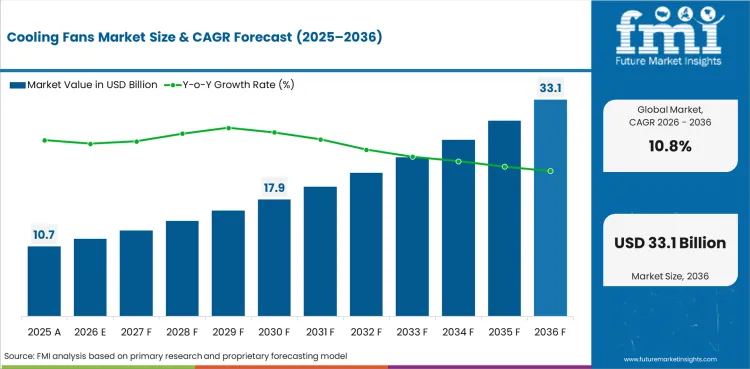
The cooling fans market was valued at USD 10.7 billion in 2025 and is expected to reach USD 11.9 billion in 2026. The market is projected to reach USD 33.1 billion by 2036 and is anticipated to register a 10.8% CAGR during the forecast period. Axial fans are expected to lead the type of fans segment with a 57.3% share in 2026, while consumer electronics are likely to account for 34.6% share of application revenue in 2026.
Summary of the Cooling Fans Market
- Demand and Growth Drivers
- Data center expansion is expected to increase demand for compact and energy-efficient thermal management fans.
- Electric vehicle adoption is likely to support fan use in battery and power electronics cooling.
- Energy efficiency rules are anticipated to increase replacement demand for DC and brushless fan technologies.
- Product and Segment View
- Axial fans are expected to lead fan type due to wide use in electronics and data center cooling.
- Consumer electronics are likely to remain the main application as devices generate higher thermal loads.
- Direct sales are anticipated to stay important because OEM procurement remains central to fan supply.
- Geography and Competitive Outlook
- The EU is expected to expand faster due to energy efficiency regulation and automotive electrification.
- South Korea is likely to show strong growth as semiconductor and electronics production require precision cooling.
- Companies with stronger brushless technology and OEM relationships are anticipated to improve market position.
- Analyst Opinion
- Ronak Shah, Principal consultant for Consumer Product at FMI, suggests, “The cooling fans market is moving toward higher-efficiency thermal management systems across electronics, data centers and electric vehicles. Suppliers with compact axial fan designs and brushless technology are likely to gain advantage as buyers focus on airflow performance and lower energy use.”
- Cooling Fans Market Value Analysis
- The cooling fans market is moving deeper into thermal management for electronics and electrified systems.
- Revenue is likely to rise as data centers and high-performance devices require more efficient cooling.
- Adoption is expected to increase where brushless and DC fans reduce energy use across operating systems.
- Spending is anticipated to be backed by EV cooling needs and wider deployment of compact electronics.
Key Takeaways, Market Size, and Forecast
- The cooling fans market was valued at USD 10.7 billion in 2025.
- The cooling fans market is expected to reach USD 11.9 billion in 2026.
- By 2036, the cooling fans market is projected to reach USD 33.1 billion.
- From 2026 to 2036, the market is anticipated to expand at a 10.8% CAGR.
- Axial fans are expected to account for 57.3% share of the type of fans segment in 2026.
- Consumer electronics are likely to hold 34.6% share of the application segment in 2026.
- The EU is projected to record the fastest country-level expansion at 11.0% CAGR by 2036.
Cooling Fans Market Definition
The cooling fans market encompasses axial, centrifugal, and specialty fans used for thermal management across consumer electronics, telecom/datacom, automotive, industrial, and other applications.
Cooling Fans Market Inclusions
Market scope encompasses all commercially traded cooling fans market products categorized by type of fans, application, sales channel, technology. The range of revenue sizes is from 2026 to 2036.
Cooling Fans Market Exclusions
The scope does not include products outside the defined segmentation taxonomy, raw materials not processed for end-use applications, or adjacent categories that do not compete directly within the cooling fans market framework.
Cooling Fans Market Research Methodology
- Primary Research: FMI analysts conducted interviews with industry participants, manufacturers, distributors, and end-use specialists across key markets.
- Desk Research: Combined data from industry associations, regulatory bodies, trade publications, and manufacturer disclosures.
- Market sizing and forecasting: Bottom-up methodology aggregating data across segments and regions, with regional adoption curves and cross-validation.
- Data validation: Cross-checked quarterly against global production data and manufacturer-reported information.
Why is the Cooling Fans Market Growing?
- Data center expansion and high-performance computing growth are creating sustained demand for efficient thermal management fans that deliver high airflow in compact form factors.
- Electric vehicle adoption and automotive electrification are generating new demand for cooling fans in battery thermal management, power electronics, and motor cooling applications.
- Energy efficiency regulations and the transition from AC to DC and brushless fan technologies are driving upgrade cycles across industrial and commercial applications.
The cooling fans market reflects growing thermal management requirements driven by data center expansion, consumer electronics densification, and automotive electrification. Axial fans dominate at 57.3% of the type of fans segment, reflecting their widespread use in electronics cooling, data center racks, and automotive systems where high airflow and compact installation are essential. Consumer electronics account for 34.6% of the application segment, though telecom/datacom is the fastest-growing category driven by hyperscale data center construction.
Direct sales lead distribution at 49.8%, reflecting the OEM-driven nature of the market where cooling fan manufacturers supply directly to electronics, automotive, and industrial equipment makers. AC fans hold 44.1% of the technology segment, though DC and brushless technologies are gaining share due to superior energy efficiency, speed control capability, and longer operational life.
The EU (11.0%) and South Korea (10.9%) lead growth, reflecting strong industrial bases, data center investment, and energy efficiency regulation. Japanese manufacturers including Nidec, MinebeaMitsumi, and Sanyo Denki maintain global leadership through bearing technology, miniaturization expertise, and long-standing OEM relationships with electronics and automotive companies.
Market Segmentation Analysis
- Axial fans hold 57.3% of the type of fans segment in 2026, driven by widespread application in electronics, data centers, and automotive thermal management.
- Consumer electronics account for 34.6% of the application segment, with telecom/datacom emerging as the fastest-growing category.
- Direct sales lead at 49.8%, reflecting OEM-driven procurement patterns across electronics and industrial equipment manufacturing.
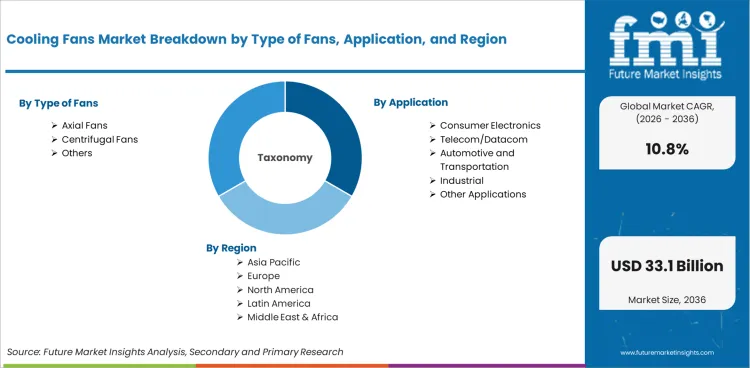
The cooling fans market is segmented by type of fans (axial fans, centrifugal fans, others), application (consumer electronics, telecom/datacom, automotive and transportation, industrial, other applications), sales channel (direct sales, specialty stores, multi-brand stores, online retailing, others), and technology (AC fans, DC fans, brushless fans).
Insights into the Axial Fans Type Segment
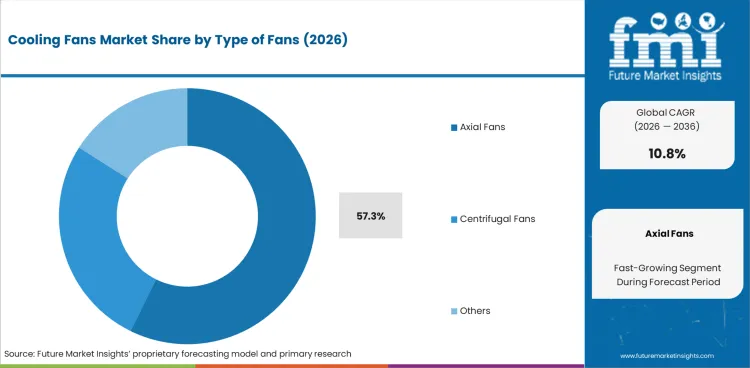
In 2026, axial fans are expected to hold 57.3% of the type of fans segment. Axial fans deliver high-volume airflow in compact designs, making them the default choice for server rack cooling, laptop and desktop thermal management, and automotive cooling applications. Miniaturization and energy efficiency improvements continue to expand axial fan applications across emerging use cases including EV battery cooling.
Insights into the Consumer Electronics Application Segment
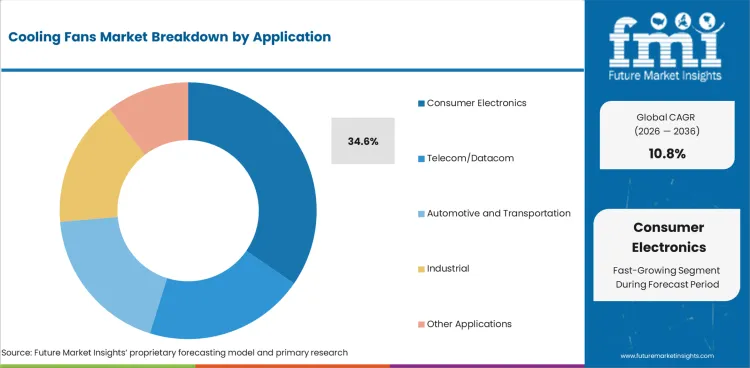
Consumer electronics account for 34.6% of the application segment in 2026. Smartphones, laptops, gaming consoles, and desktop PCs rely on compact cooling fans for thermal management. The trend toward higher processing power, 5G connectivity, and AI-capable devices is increasing heat generation, creating demand for more efficient and quieter cooling solutions.
Cooling Fans Market Drivers, Restraints, and Opportunities
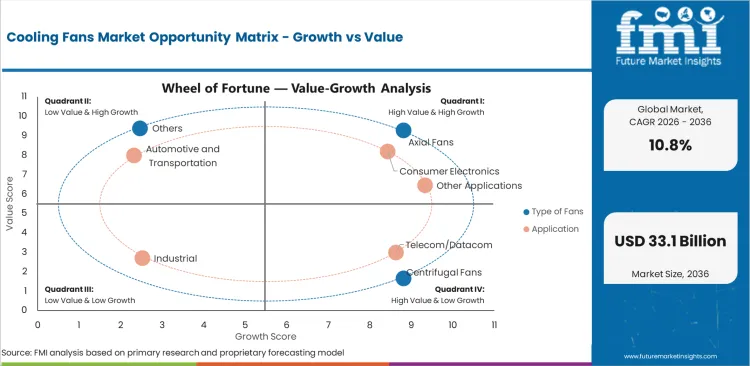
- Data center proliferation and cloud computing expansion are creating high-volume demand for energy-efficient cooling fans with precise thermal management capabilities.
- Noise sensitivity in consumer applications and workspace environments creates design constraints that require advanced bearing technology and aerodynamic optimization.
- Automotive electrification is creating a new, high-growth application segment for cooling fans in battery, motor, and power electronics thermal management.
The cooling fans market continues to expand as thermal management requirements intensify across data centers, consumer electronics, automotive, and industrial applications. Challenges include noise constraints and the need for continuous miniaturization. Opportunities are concentrated in EV cooling, data center efficiency, and smart fan technology.
Data Center and Cloud Computing Expansion
Demand reflects the rapid construction of hyperscale and edge data centers to support cloud computing, AI workloads, and 5G infrastructure. Each data center rack requires multiple cooling fans, creating high-volume procurement opportunities for fans with optimized airflow-to-power ratios.
Automotive Electrification and EV Cooling
Growth reflects the expanding cooling requirements of electric vehicle battery packs, power electronics, and motor systems. EV thermal management requires fans that operate reliably across wide temperature ranges while meeting automotive durability, noise, and weight specifications.
Energy Efficiency Transition from AC to DC/Brushless
Adoption is increasing due to energy efficiency regulations (EU Ecodesign, DOE standards) and the superior performance characteristics of DC and electronically commutated (EC) fans. These technologies offer variable speed control, lower power consumption, and longer operational life compared to traditional AC fans.
Analysis of Cooling Fans Market By Key Countries
.webp "Top Country Growth Comparison Cooling Fans Market Cagr (2026 2036)")
| Country | CAGR |
|---|---|
| USA | 10.5% |
| UK | 10.2% |
| EU | 11% |
| Japan | 10.6% |
| South Korea | 10.9% |
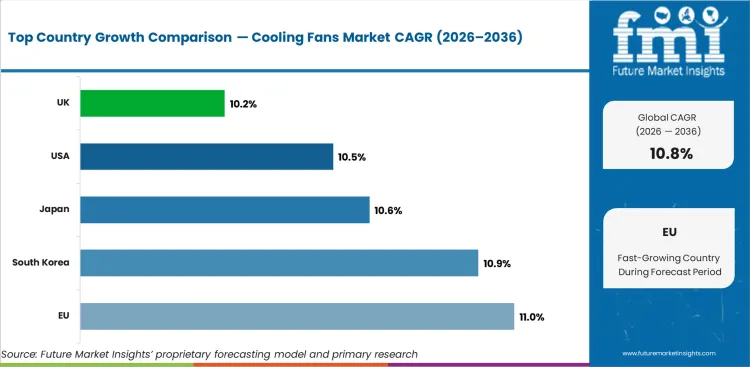
- The EU (11.0%) and South Korea (10.9%) lead growth, driven by data center investment, automotive electrification, and energy efficiency regulation.
- The USA (10.5%) sustains demand through hyperscale data center construction, defense electronics, and EV manufacturing expansion.
- Japan (10.6%) reflects strong industrial fan manufacturing and growing automotive electrification demand.
The global cooling fans market is projected to expand at a CAGR of 10.8% from 2026 to 2036. The analysis covers more than 30 countries, and the primary markets are detailed below.
Demand Outlook for Cooling Fans Market in the United States
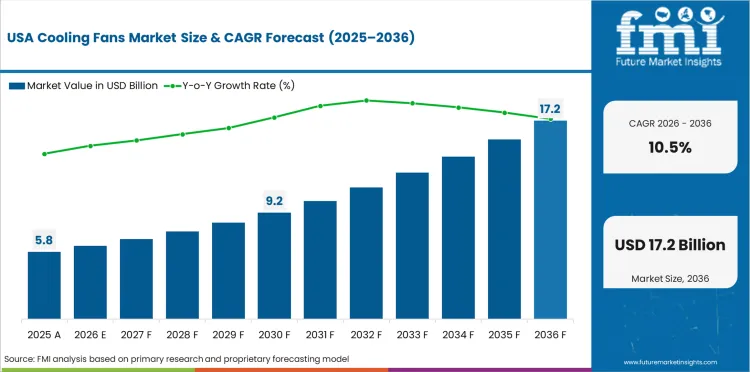
The USA is projected to grow at 10.5% through 2036, supported by hyperscale data center investment, defense electronics thermal requirements, and expanding EV manufacturing.
- Data center construction drives high-volume cooling fan procurement.
- Defense electronics create demand for high-reliability thermal management.
- EV manufacturing expansion generates new automotive fan applications.
Future Outlook for Cooling Fans Market in the United Kingdom
The UK is projected to grow at 10.2% through 2036, driven by data center investment, industrial automation, and energy efficiency regulation.
- Data center investment sustains thermal management fan demand.
- Industrial automation drives precision cooling fan adoption.
- Energy efficiency regulation accelerates DC and brushless fan transitions.
Opportunity Analysis of Cooling Fans Market in the EU
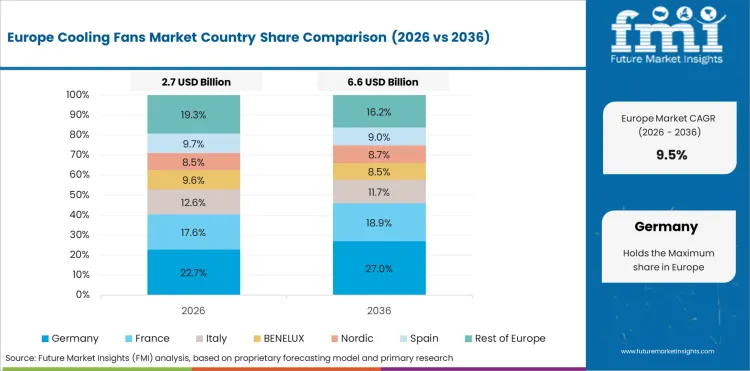
The EU is projected to grow at 11.0% through 2036, reflecting Ecodesign regulation, automotive electrification leadership, and strong industrial manufacturing base.
- Ecodesign regulation drives energy-efficient fan adoption.
- Automotive electrification creates EV cooling fan demand.
- Industrial manufacturing base sustains process cooling requirements.
In-depth Analysis of Cooling Fans Market in Japan
Japan is projected to grow at 10.6% through 2036, driven by industrial fan manufacturing expertise, automotive electrification, and consumer electronics thermal management.
- Industrial manufacturing expertise sustains global supply leadership.
- Automotive electrification generates domestic EV fan demand.
- Consumer electronics miniaturization drives compact fan innovation.
Sales Analysis of Cooling Fans Market in South Korea
South Korea is projected to grow at 10.9% through 2036, supported by semiconductor manufacturing cooling needs, data center expansion, and consumer electronics production.
- Semiconductor manufacturing drives precision cooling demand.
- Data center expansion creates high-volume procurement opportunities.
- Consumer electronics production sustains compact fan requirements.
Competitive Landscape and Strategic Positioning
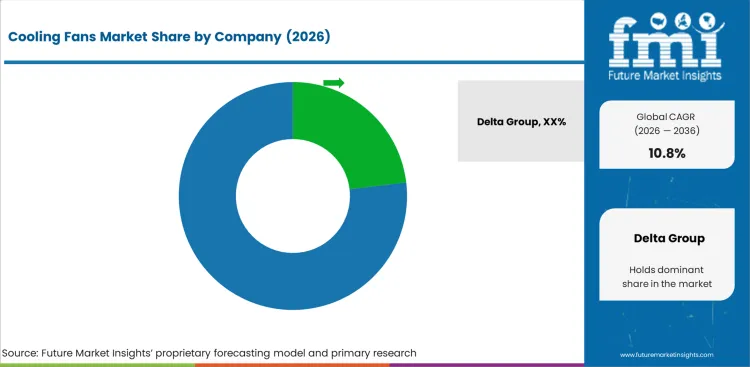
- Delta Group leads with 23.1% market share, supported by comprehensive thermal management solutions, strong OEM relationships, and global manufacturing scale across data center, industrial, and automotive applications.
- Nidec Corporation and EBM-Papst Group hold strong positions through motor technology expertise and deep integration with automotive and industrial equipment manufacturers.
- Japanese manufacturers including MinebeaMitsumi and Sanyo Denki maintain leadership through bearing technology, miniaturization, and long-standing OEM partnerships.
Delta Group leads the market with 23.1% share, leveraging its comprehensive portfolio of axial, centrifugal, and blower fans for data center, telecom, and industrial applications. The company's scale manufacturing in Asia and established relationships with hyperscale cloud operators reinforce its dominant position.
Nidec Corporation competes through motor technology leadership and diversified cooling solutions spanning automotive, industrial, and consumer electronics. EBM-Papst Group leads in European industrial and HVAC fan applications through EC motor technology and energy efficiency expertise.
MinebeaMitsumi (NMB Technologies) and SUNON Group serve the consumer electronics and IT cooling segments with miniaturized fan designs. Ziehl-Abegg SE focuses on industrial ventilation and HVAC applications in Europe.
Barriers include the capital intensity of precision fan manufacturing, the need for application-specific engineering expertise, and established OEM supplier relationships that create customer switching costs. Strategic priorities include EC/brushless technology transition, EV cooling product development, and data center thermal management optimization.
Key Companies in the Cooling Fans Market
Key global companies leading the cooling fans market include:
- Delta Group (Taiwan), MinebeaMitsumi Inc., NMB Technologies (Japan), SUNON Group (Taiwan), Nidec Corporation (Japan), EBM-Papst Group (Germany) have strong market infrastructure, established relationships, and broad product portfolios.
- Ziehl-Abegg SE (Germany), Sanyo Denki Co., Ltd. (Japan), Oriental Motor Co., Ltd. (Japan), Comair Rotron (USA) have established positions through specialized capabilities and focused strategies.
- Pelonis Technologies, Inc. (USA), Horton Holding Inc. (USA) are among the emerging players developing specialized approaches.
Competitive Benchmarking: Cooling Fans Market
| Company | Thermal Technology | Product Range | OEM Relationships | Geographic Reach |
|---|---|---|---|---|
| Delta Group | Very High | High | Strong | Global |
| MinebeaMitsumi (NMB) | Very High | High | Strong | Global |
| SUNON Group | High | Medium | Strong | Asia, Global |
| Nidec Corporation | Very High | High | Strong | Global |
| EBM-Papst Group | Very High | High | Strong | Europe, Global |
| Ziehl-Abegg SE | High | Medium | Moderate | Europe |
| Sanyo Denki | High | Medium | Moderate | Asia, Global |
| Oriental Motor | High | Medium | Moderate | Asia |
| Pelonis Technologies | Medium | Medium | Moderate | N. America |
Source: Future Market Insights competitive analysis, 2026.
Key Developments in Cooling Fans Market
- In 2025, Delta Group launched a high-efficiency EC axial fan series for data center cooling applications, delivering 30% energy savings compared to previous AC-powered models.
- In 2025, EBM-Papst Group introduced a brushless DC centrifugal fan with integrated smart controls for HVAC and industrial ventilation systems in Europe.
Key Players in the Cooling Fans Market
Major Global Players
- Delta Group (Taiwan)
- MinebeaMitsumi Inc., NMB Technologies (Japan)
- SUNON Group (Taiwan)
- Nidec Corporation (Japan)
- EBM-Papst Group (Germany)
Emerging Players/Startups
- Ziehl-Abegg SE (Germany)
- Sanyo Denki Co., Ltd. (Japan)
- Oriental Motor Co., Ltd. (Japan)
- Comair Rotron (USA)
- Pelonis Technologies, Inc. (USA)
- Horton Holding Inc. (USA)
Report Scope and Coverage
| Parameter | Details |
|---|---|
| Quantitative Units | USD 11.86 billion to USD 33.06 billion, at a CAGR of 10.8% |
| Market Definition | The cooling fans market encompasses axial, centrifugal, and specialty fans used for thermal management across consumer electronics, telecom/datacom, automotive, industrial, and other applications. |
| Regions Covered | North America, Latin America, Europe, East Asia, South Asia and Pacific, Middle East and Africa |
| Countries Covered | USA, UK, France, Germany, Italy, South Korea, Japan, China, Taiwan, India, 30 plus countries |
| Key Companies Profiled | Delta Group, MinebeaMitsumi Inc. (NMB Technologies), SUNON Group, Nidec Corporation, EBM-Papst Group, Ziehl-Abegg SE, Sanyo Denki Co., Ltd., Oriental Motor Co., Ltd., Comair Rotron, Pelonis Technologies, Inc., Horton Holding Inc. |
| Forecast Period | 2026 to 2036 |
| Approach | Hybrid bottom-up and top-down methodology starting with verified transaction data, projecting adoption velocity across segments and regions. |
Segmentation
Cooling Fans Market Segmented by Type of Fans:
- Axial Fans
- Centrifugal Fans
- Others
Cooling Fans Market Segmented by Application:
- Consumer Electronics
- Telecom/Datacom
- Automotive and Transportation
- Industrial
- Other Applications
Cooling Fans Market Segmented by Sales Channel:
- Direct Sales
- Specialty Stores
- Multi-brand Stores
- Online Retailing
- Others
Cooling Fans Market Segmented by Technology:
- AC Fans
- DC Fans
- Brushless Fans
Cooling Fans Market by Region:
- North America
- USA
- Canada
- Mexico
- Latin America
- Brazil
- Chile
- Rest of Latin America
- Western Europe
- Germany
- UK
- Italy
- Spain
- France
- Nordic
- BENELUX
- Rest of Western Europe
- Eastern Europe
- Russia
- Poland
- Hungary
- Balkan & Baltic
- Rest of Eastern Europe
- East Asia
- China
- Japan
- South Korea
- South Asia and Pacific
- India
- ASEAN
- Australia & New Zealand
- Rest of South Asia and Pacific
- Middle East & Africa
- Kingdom of Saudi Arabia
- Other GCC Countries
- Turkiye
- South Africa
- Other African Union
- Rest of Middle East & Africa
Research Sources and Bibliography
- 1. International Energy Agency. (2025). IEA Data Centre Energy Efficiency Report: Cooling Infrastructure Trends. IEA.
- 2. European Commission. (2024). EU Ecodesign Directive: Fan and Motor Energy Efficiency Standards. EC.
- 3. USA Department of Energy. (2025). DOE Industrial Motor and Fan Efficiency Standards. DOE.
- 4. International Electrotechnical Commission. (2025). IEC Standards for Cooling Fan Performance and Safety. IEC.
- 5. Semiconductor Industry Association. (2025). SIA Global Semiconductor Industry Report: Thermal Management Requirements. SIA.
This bibliography is provided for reader reference.
This Report Answers
- Estimating the size of the market and revenue potential from 2026 to 2036.
- Segmentation by type of fans, application, sales channel, and technology.
- Insights about more than 30 markets across key regions.
- Analysis of thermal management technology, energy efficiency, and automotive cooling trends.
- Assessment of the competitive landscape and OEM supplier positioning.
- Identifying investment opportunities in data center cooling, EV thermal management, and smart fan technology.
- Tracking energy efficiency regulation and technology transition patterns.
- Delivery of data in PDF and Excel formats.
Frequently Asked Questions
What is the global market demand for Cooling Fans in 2026?
In 2026, the global cooling fans market is expected to be worth USD 11.86 billion.
How big will the Cooling Fans Market be in 2036?
By 2036, the cooling fans market is expected to be worth USD 33.06 billion.
How much is demand for Cooling Fans expected to grow between 2026 and 2036?
Between 2026 and 2036, demand for cooling fans is expected to grow at a CAGR of 10.8%.
Which fan type is expected to lead the market in 2026?
Axial fans are expected to hold 57.3% of the type of fans segment in 2026, driven by widespread use in electronics, data centers, and automotive thermal management.
What is causing demand to rise in the EU?
The EU is projected to grow at 11.0% through 2036, driven by Ecodesign regulation, automotive electrification, and strong industrial manufacturing base.
What is causing demand to rise in South Korea?
South Korea is projected to grow at 10.9% through 2036, driven by semiconductor manufacturing cooling needs and data center expansion.
What does this report mean by Cooling Fans Market definition?
The cooling fans market encompasses axial, centrifugal, and specialty fans used for thermal management across consumer electronics, telecom/datacom, automotive, industrial, and other applications.
Preview the report firsthand - request a free sample
Get SampleGet the brochure for pricing and purchase details.
Get PDFTable of Content
- Executive Summary
- Global Market Outlook
- Demand-side Trends
- Supply-side Trends
- Technology Roadmap Analysis
- Analysis and Recommendations
- Market Overview
- Market Coverage / Taxonomy
- Market Definition / Scope / Limitations
- Research Methodology
- Chapter Orientation
- Analytical Lens and Working Hypotheses
- Market Structure, Signals, and Trend Drivers
- Benchmarking and Cross-market Comparability
- Market Sizing, Forecasting, and Opportunity Mapping
- Research Design and Evidence Framework
- Desk Research Programme (Secondary Evidence)
- Company Annual and Sustainability Reports
- Peer-reviewed Journals and Academic Literature
- Corporate Websites, Product Literature, and Technical Notes
- Earnings Decks and Investor Briefings
- Statutory Filings and Regulatory Disclosures
- Technical White Papers and Standards Notes
- Trade Journals, Industry Magazines, and Analyst Briefs
- Conference Proceedings, Webinars, and Seminar Materials
- Government Statistics Portals and Public Data Releases
- Press Releases and Reputable Media Coverage
- Specialist Newsletters and Curated Briefings
- Sector Databases and Reference Repositories
- FMI Internal Proprietary Databases and Historical Market Datasets
- Subscription Datasets and Paid Sources
- Social Channels, Communities, and Digital Listening Inputs
- Additional Desk Sources
- Expert Input and Fieldwork (Primary Evidence)
- Primary Modes
- Qualitative Interviews and Expert Elicitation
- Quantitative Surveys and Structured Data Capture
- Blended Approach
- Why Primary Evidence is Used
- Field Techniques
- Interviews
- Surveys
- Focus Groups
- Observational and In-context Research
- Social and Community Interactions
- Stakeholder Universe Engaged
- C-suite Leaders
- Board Members
- Presidents and Vice Presidents
- R&D and Innovation Heads
- Technical Specialists
- Domain Subject-matter Experts
- Scientists
- Physicians and Other Healthcare Professionals
- Governance, Ethics, and Data Stewardship
- Research Ethics
- Data Integrity and Handling
- Primary Modes
- Tooling, Models, and Reference Databases
- Desk Research Programme (Secondary Evidence)
- Data Engineering and Model Build
- Data Acquisition and Ingestion
- Cleaning, Normalisation, and Verification
- Synthesis, Triangulation, and Analysis
- Quality Assurance and Audit Trail
- Market Background
- Market Dynamics
- Drivers
- Restraints
- Opportunity
- Trends
- Scenario Forecast
- Demand in Optimistic Scenario
- Demand in Likely Scenario
- Demand in Conservative Scenario
- Opportunity Map Analysis
- Product Life Cycle Analysis
- Supply Chain Analysis
- Investment Feasibility Matrix
- Value Chain Analysis
- PESTLE and Porter’s Analysis
- Regulatory Landscape
- Regional Parent Market Outlook
- Production and Consumption Statistics
- Import and Export Statistics
- Market Dynamics
- Global Market Analysis 2021 to 2025 and Forecast, 2026 to 2036
- Historical Market Size Value (USD billion) Analysis, 2021 to 2025
- Current and Future Market Size Value (USD billion) Projections, 2026 to 2036
- Y-o-Y Growth Trend Analysis
- Absolute $ Opportunity Analysis
- Global Market Pricing Analysis 2021 to 2025 and Forecast 2026 to 2036
- Global Market Analysis 2021 to 2025 and Forecast 2026 to 2036, By Type of Fans
- Introduction / Key Findings
- Historical Market Size Value (USD billion) Analysis By Type of Fans , 2021 to 2025
- Current and Future Market Size Value (USD billion) Analysis and Forecast By Type of Fans , 2026 to 2036
- Axial Fans
- Centrifugal Fans
- Others
- Axial Fans
- Y-o-Y Growth Trend Analysis By Type of Fans , 2021 to 2025
- Absolute $ Opportunity Analysis By Type of Fans , 2026 to 2036
- Global Market Analysis 2021 to 2025 and Forecast 2026 to 2036, By Application
- Introduction / Key Findings
- Historical Market Size Value (USD billion) Analysis By Application, 2021 to 2025
- Current and Future Market Size Value (USD billion) Analysis and Forecast By Application, 2026 to 2036
- Consumer Electronics
- Telecom/Datacom
- Automotive and Transportation
- Industrial
- Other Applications
- Consumer Electronics
- Y-o-Y Growth Trend Analysis By Application, 2021 to 2025
- Absolute $ Opportunity Analysis By Application, 2026 to 2036
- Global Market Analysis 2021 to 2025 and Forecast 2026 to 2036, By Sales Channel
- Introduction / Key Findings
- Historical Market Size Value (USD billion) Analysis By Sales Channel, 2021 to 2025
- Current and Future Market Size Value (USD billion) Analysis and Forecast By Sales Channel, 2026 to 2036
- Direct Sales
- Specialty Stores
- Multi-brand Stores
- Online Retailing
- Others
- Direct Sales
- Y-o-Y Growth Trend Analysis By Sales Channel, 2021 to 2025
- Absolute $ Opportunity Analysis By Sales Channel, 2026 to 2036
- Global Market Analysis 2021 to 2025 and Forecast 2026 to 2036, By Technology
- Introduction / Key Findings
- Historical Market Size Value (USD billion) Analysis By Technology, 2021 to 2025
- Current and Future Market Size Value (USD billion) Analysis and Forecast By Technology, 2026 to 2036
- AC Fans
- DC Fans
- Brushless Fans
- AC Fans
- Y-o-Y Growth Trend Analysis By Technology, 2021 to 2025
- Absolute $ Opportunity Analysis By Technology, 2026 to 2036
- Global Market Analysis 2021 to 2025 and Forecast 2026 to 2036, By Region
- Introduction
- Historical Market Size Value (USD billion) Analysis By Region, 2021 to 2025
- Current Market Size Value (USD billion) Analysis and Forecast By Region, 2026 to 2036
- North America
- Latin America
- Western Europe
- Eastern Europe
- East Asia
- South Asia and Pacific
- Middle East & Africa
- Market Attractiveness Analysis By Region
- North America Market Analysis 2021 to 2025 and Forecast 2026 to 2036, By Country
- Historical Market Size Value (USD billion) Trend Analysis By Market Taxonomy, 2021 to 2025
- Market Size Value (USD billion) Forecast By Market Taxonomy, 2026 to 2036
- By Country
- USA
- Canada
- Mexico
- By Type of Fans
- By Application
- By Sales Channel
- By Technology
- By Country
- Market Attractiveness Analysis
- By Country
- By Type of Fans
- By Application
- By Sales Channel
- By Technology
- Key Takeaways
- Latin America Market Analysis 2021 to 2025 and Forecast 2026 to 2036, By Country
- Historical Market Size Value (USD billion) Trend Analysis By Market Taxonomy, 2021 to 2025
- Market Size Value (USD billion) Forecast By Market Taxonomy, 2026 to 2036
- By Country
- Brazil
- Chile
- Rest of Latin America
- By Type of Fans
- By Application
- By Sales Channel
- By Technology
- By Country
- Market Attractiveness Analysis
- By Country
- By Type of Fans
- By Application
- By Sales Channel
- By Technology
- Key Takeaways
- Western Europe Market Analysis 2021 to 2025 and Forecast 2026 to 2036, By Country
- Historical Market Size Value (USD billion) Trend Analysis By Market Taxonomy, 2021 to 2025
- Market Size Value (USD billion) Forecast By Market Taxonomy, 2026 to 2036
- By Country
- Germany
- UK
- Italy
- Spain
- France
- Nordic
- BENELUX
- Rest of Western Europe
- By Type of Fans
- By Application
- By Sales Channel
- By Technology
- By Country
- Market Attractiveness Analysis
- By Country
- By Type of Fans
- By Application
- By Sales Channel
- By Technology
- Key Takeaways
- Eastern Europe Market Analysis 2021 to 2025 and Forecast 2026 to 2036, By Country
- Historical Market Size Value (USD billion) Trend Analysis By Market Taxonomy, 2021 to 2025
- Market Size Value (USD billion) Forecast By Market Taxonomy, 2026 to 2036
- By Country
- Russia
- Poland
- Hungary
- Balkan & Baltic
- Rest of Eastern Europe
- By Type of Fans
- By Application
- By Sales Channel
- By Technology
- By Country
- Market Attractiveness Analysis
- By Country
- By Type of Fans
- By Application
- By Sales Channel
- By Technology
- Key Takeaways
- East Asia Market Analysis 2021 to 2025 and Forecast 2026 to 2036, By Country
- Historical Market Size Value (USD billion) Trend Analysis By Market Taxonomy, 2021 to 2025
- Market Size Value (USD billion) Forecast By Market Taxonomy, 2026 to 2036
- By Country
- China
- Japan
- South Korea
- By Type of Fans
- By Application
- By Sales Channel
- By Technology
- By Country
- Market Attractiveness Analysis
- By Country
- By Type of Fans
- By Application
- By Sales Channel
- By Technology
- Key Takeaways
- South Asia and Pacific Market Analysis 2021 to 2025 and Forecast 2026 to 2036, By Country
- Historical Market Size Value (USD billion) Trend Analysis By Market Taxonomy, 2021 to 2025
- Market Size Value (USD billion) Forecast By Market Taxonomy, 2026 to 2036
- By Country
- India
- ASEAN
- Australia & New Zealand
- Rest of South Asia and Pacific
- By Type of Fans
- By Application
- By Sales Channel
- By Technology
- By Country
- Market Attractiveness Analysis
- By Country
- By Type of Fans
- By Application
- By Sales Channel
- By Technology
- Key Takeaways
- Middle East & Africa Market Analysis 2021 to 2025 and Forecast 2026 to 2036, By Country
- Historical Market Size Value (USD billion) Trend Analysis By Market Taxonomy, 2021 to 2025
- Market Size Value (USD billion) Forecast By Market Taxonomy, 2026 to 2036
- By Country
- Kingdom of Saudi Arabia
- Other GCC Countries
- Turkiye
- South Africa
- Other African Union
- Rest of Middle East & Africa
- By Type of Fans
- By Application
- By Sales Channel
- By Technology
- By Country
- Market Attractiveness Analysis
- By Country
- By Type of Fans
- By Application
- By Sales Channel
- By Technology
- Key Takeaways
- Key Countries Market Analysis
- USA
- Pricing Analysis
- Market Share Analysis, 2025
- By Type of Fans
- By Application
- By Sales Channel
- By Technology
- Canada
- Pricing Analysis
- Market Share Analysis, 2025
- By Type of Fans
- By Application
- By Sales Channel
- By Technology
- Mexico
- Pricing Analysis
- Market Share Analysis, 2025
- By Type of Fans
- By Application
- By Sales Channel
- By Technology
- Brazil
- Pricing Analysis
- Market Share Analysis, 2025
- By Type of Fans
- By Application
- By Sales Channel
- By Technology
- Chile
- Pricing Analysis
- Market Share Analysis, 2025
- By Type of Fans
- By Application
- By Sales Channel
- By Technology
- Germany
- Pricing Analysis
- Market Share Analysis, 2025
- By Type of Fans
- By Application
- By Sales Channel
- By Technology
- UK
- Pricing Analysis
- Market Share Analysis, 2025
- By Type of Fans
- By Application
- By Sales Channel
- By Technology
- Italy
- Pricing Analysis
- Market Share Analysis, 2025
- By Type of Fans
- By Application
- By Sales Channel
- By Technology
- Spain
- Pricing Analysis
- Market Share Analysis, 2025
- By Type of Fans
- By Application
- By Sales Channel
- By Technology
- France
- Pricing Analysis
- Market Share Analysis, 2025
- By Type of Fans
- By Application
- By Sales Channel
- By Technology
- India
- Pricing Analysis
- Market Share Analysis, 2025
- By Type of Fans
- By Application
- By Sales Channel
- By Technology
- ASEAN
- Pricing Analysis
- Market Share Analysis, 2025
- By Type of Fans
- By Application
- By Sales Channel
- By Technology
- Australia & New Zealand
- Pricing Analysis
- Market Share Analysis, 2025
- By Type of Fans
- By Application
- By Sales Channel
- By Technology
- China
- Pricing Analysis
- Market Share Analysis, 2025
- By Type of Fans
- By Application
- By Sales Channel
- By Technology
- Japan
- Pricing Analysis
- Market Share Analysis, 2025
- By Type of Fans
- By Application
- By Sales Channel
- By Technology
- South Korea
- Pricing Analysis
- Market Share Analysis, 2025
- By Type of Fans
- By Application
- By Sales Channel
- By Technology
- Russia
- Pricing Analysis
- Market Share Analysis, 2025
- By Type of Fans
- By Application
- By Sales Channel
- By Technology
- Poland
- Pricing Analysis
- Market Share Analysis, 2025
- By Type of Fans
- By Application
- By Sales Channel
- By Technology
- Hungary
- Pricing Analysis
- Market Share Analysis, 2025
- By Type of Fans
- By Application
- By Sales Channel
- By Technology
- Kingdom of Saudi Arabia
- Pricing Analysis
- Market Share Analysis, 2025
- By Type of Fans
- By Application
- By Sales Channel
- By Technology
- Turkiye
- Pricing Analysis
- Market Share Analysis, 2025
- By Type of Fans
- By Application
- By Sales Channel
- By Technology
- South Africa
- Pricing Analysis
- Market Share Analysis, 2025
- By Type of Fans
- By Application
- By Sales Channel
- By Technology
- USA
- Market Structure Analysis
- Competition Dashboard
- Competition Benchmarking
- Market Share Analysis of Top Players
- By Regional
- By Type of Fans
- By Application
- By Sales Channel
- By Technology
- Competition Analysis
- Competition Deep Dive
- Delta Group
- Overview
- Product Portfolio
- Profitability by Market Segments (Product/Age /Sales Channel/Region)
- Sales Footprint
- Strategy Overview
- Marketing Strategy
- Product Strategy
- Channel Strategy
- MinebeaMitsumi Inc. (NMB Technologies)
- SUNON Group
- Nidec Corporation
- EBM-Papst Group
- Ziehl-Abegg SE
- Sanyo Denki Co., Ltd.
- Oriental Motor Co., Ltd.
- Comair Rotron
- Pelonis Technologies, Inc.
- Horton Holding Inc.
- Delta Group
- Competition Deep Dive
- Assumptions & Acronyms Used


